Malta Information: Key Facts About the Country
Small in size but rich in history, Malta is an independent island state, a member of the European Union and the eurozone, where English is an official language. Before you travel, a few basics are all you need to understand the country: its capital, population, languages and currency, and the plugs you will find in your hotel room.
This fact sheet brings the essentials together at a glance, with figures checked against official sources. For anecdotes and quirks of the country, see also our 21 things to know about tourism in Malta.
Malta in key figures
The table below brings together the official information on the Republic of Malta. Where we have one, each row links to our detailed page on the subject.
| Topic | Information |
|---|---|
| Official name | Republic of Malta (Repubblika ta’ Malta in Maltese) |
| Location | An archipelago in the middle of the Mediterranean, 93 km south of Sicily and 288 km from the coast of North Africa: see where Malta is |
| Capital | Valletta (Il-Belt Valletta), seat of the government and Parliament: guide to Valletta |
| Area | 316 km², of which 246 km² for the island of Malta and 67 km² for Gozo: area and size of Malta |
| Population | 574,250 inhabitants in 2024: population of Malta |
| Density | About 1,817 inhabitants per km², the highest in the European Union |
| Inhabited islands | 3: Malta, Gozo and Comino (only a handful of residents), in an archipelago of 8 islands: geography of Malta |
| Highest point | Ta’ Dmejrek, 253 m, at the top of the Dingli Cliffs |
| Official languages | Maltese (the national language) and English, plus Maltese Sign Language since 2016: languages spoken in Malta |
| Currency | The euro since 1 January 2008, replacing the Maltese lira (€1 = 0.4293 lira) |
| European Union | Member since 1 May 2004 |
| Schengen Area | Member since 21 December 2007 (air borders opened on 30 March 2008): visas and entry requirements |
| Political system | Parliamentary republic since 13 December 1974: the President, elected by Parliament for 5 years, is head of state; the Prime Minister leads the government; Parliament has a single chamber |
| National days | 31 March (Freedom Day), 7 June (Sette Giugno), 8 September (Victory Day), 21 September (Independence Day), 13 December (Republic Day), among the 14 public holidays in Malta |
| Time zone | UTC+1 (Central European Time), UTC+2 in summer: one hour ahead of the UK and Ireland all year round |
| Dialling code | +356; European emergency number: 112 |
| Internet domain | .mt |
| Electricity | 230 V, 50 Hz, type G sockets (the British three-pin model): do you need a plug adapter? |
| Driving | On the left, a British legacy: renting a car in Malta |
| Religion | Roman Catholicism, the state religion under the Constitution |
| Airport | Malta International Airport (code MLA), in Luqa, the country’s only airport: Malta Airport |
| Climate | Mediterranean: hot, dry summers and mild winters: weather and climate in Malta |
| Tourists | 4,022,310 tourists in 2025: tourism in Malta |
| English schools | 31 licensed schools and nearly 76,000 students a year: list of English schools |
Geography and climate in brief
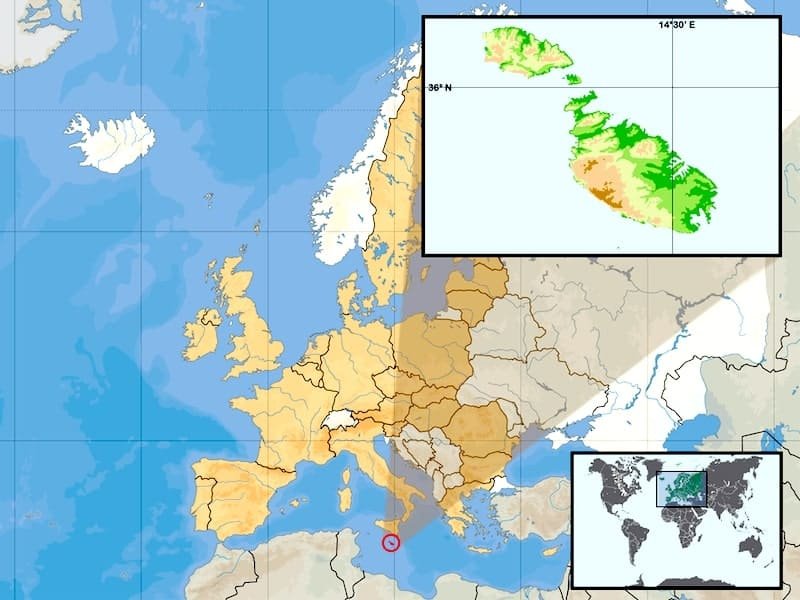
The Maltese archipelago is made up of three inhabited islands and several islets. The island of Malta is home to most of the population, towns and economic activity. Gozo, more rural and greener, is linked to Malta by ferry from Ċirkewwa (see things to do in Gozo), while Comino, between the two, is famous for its Blue Lagoon. To discover both islands from the sea, the guided kayak tour of Gozo, the Blue Lagoon and Comino is an active, accessible option.
The terrain is modest: a limestone plateau rising towards the west up to the Dingli Cliffs, with no permanent rivers or lakes. The coastline is mostly rocky, with a few sandy bays in the north and on Gozo. The Mediterranean climate brings hot, dry summers and mild winters, with rain concentrated between October and February. Month-by-month averages are on our page on the weather in Malta.
The history of Malta in 6 key dates
Its position at the heart of the Mediterranean has brought Malta a succession of rulers, each of whom left a mark that is still visible today:
- Around 3600 BC: the first megalithic temples are built, such as Ġgantija on Gozo or Ħaġar Qim, among the oldest stone buildings in the world and listed by UNESCO.
- 870: the Arab conquest. Two centuries of presence that left a deep mark on Maltese, the only Semitic language with official status in the European Union.
- 1530: Emperor Charles V hands the archipelago to the Knights of the Order of St John, who rule it for more than two and a half centuries.
- 1565: the Knights repel the Ottoman Empire in the Great Siege. Valletta is founded the following year.
- 1800: after two years of French occupation, Malta comes under British control and becomes a Crown colony, a status confirmed by the Treaty of Paris in 1814.
- 1964: independence on 21 September, within the Commonwealth. The republic is proclaimed in 1974 and Malta joins the European Union in 2004.
To link these dates to the monuments, the guided tour of Valletta takes you round the Knights’ capital with a guide.
Practical information for your stay
- Healthcare: the European Health Insurance Card (EHIC), or for UK residents the UK Global Health Insurance Card (GHIC), gives access to medically necessary care in the public system, including at Mater Dei Hospital, the country’s main hospital. Travel insurance is still advisable for private clinics and repatriation.
- Money: the euro makes everything easy, cards are accepted almost everywhere and cash machines are plentiful. Keep a little cash for small shops, markets and some taxis. The standard VAT rate is 18%.
- Mobile phones: thanks to EU roaming rules, a SIM card issued in the European Union works in Malta on the terms of your home plan. UK and Swiss plans are not covered: check your options before you go.
- Water: tap water, largely desalinated, is monitored and safe to drink, but its chlorine taste leads many visitors to prefer bottled water. Details on our page on drinking water in Malta.
- Safety: Malta is a safe destination; the usual precautions are enough in busy nightlife areas such as Paceville. See our guide to safety in Malta.
Malta and the European Union
Since joining on 1 May 2004, Malta has been the smallest member state of the European Union, both in area and in population. Maltese became one of the EU’s official languages on the same date. The country elects 6 of the 720 Members of the European Parliament and held the presidency of the Council of the European Union from January to June 2017; its next presidency is scheduled for July to December 2030. The European Union Agency for Asylum is also headquartered in Malta.
For travellers, membership has very practical effects: no roaming charges on EU plans and, for EU citizens, a valid national identity card is enough to enter. If you are coming from the UK, you will need euros and your passport. Other nationalities will find the rules that apply to them on our page on visas for Malta. As for the currency, Maltese coins feature the Maltese cross (€1 and €2), the country’s coat of arms (10, 20 and 50 cents) and the altar of the Mnajdra temple (1, 2 and 5 cents).
Frequently asked questions about Malta
Is Malta an independent country?
Yes. A former British colony, Malta has been independent since 21 September 1964 and a republic since 1974. It is part of neither Italy nor the United Kingdom.
What is the capital of Malta?
The capital is Valletta, a fortified city founded in 1566 and a UNESCO World Heritage Site. It is not the largest town in the country: it has barely 5,197 inhabitants.
What languages are spoken in Malta?
The two official languages are Maltese and English, plus Maltese Sign Language. English is understood almost everywhere, and Italian is still fairly widespread. More details on our page on languages in Malta.
What currency is used in Malta?
The euro, since 1 January 2008. If you are travelling from the UK, the US or anywhere outside the eurozone, you will need euros, but cards are accepted almost everywhere.
Do I need a passport to go to Malta?
Yes, unless you are an EU citizen: Malta is in the Schengen Area, so EU citizens can travel with a valid national identity card. British, American and other travellers need a passport and should check the entry rules on our page on visas for Malta.
Is there a time difference between Malta and the UK?
Yes, Malta is one hour ahead of the UK and Ireland all year round. It runs on Central European Time (UTC+1, UTC+2 in summer), the same as France, Italy or Germany.
What are the people of Malta called?
They are the Maltese (Maltin in Maltese). The people of Gozo also call themselves Gozitans (Għawdxin), while of course being Maltese nationals.
With these basics in mind, you know the essentials about Malta: a small, English-speaking European country where travellers find their feet easily. To go further, our 11 tips before you travel to Malta and our pick of the must-see attractions will help you plan your trip.