The British in Malta: history, community and life on the island
Few places outside the United Kingdom feel as familiar to British visitors as Malta. You drive on the left, plug your phone charger into a three-pin socket, post your cards in a red pillar box and order in English everywhere. More than 160 years of British rule have left deep traces, and today Britons are both the island’s largest group of tourists and one of its main foreign communities.
Here is what you need to know about the British in Malta: shared history, figures, post-Brexit status, retirement, healthcare and the places where the British connection is still alive.
The British legacy you notice on day one
- The English language: English is an official language alongside Maltese, used in parliament, the courts, business and most signs. Read more in our guide to the languages spoken in Malta.
- Driving on the left, with right-hand drive cars, roundabouts and a road culture that will feel natural to UK drivers.
- UK-style plugs: Malta uses type G three-pin sockets, so British chargers work without an electrical adapter.
- Red telephone and post boxes, some still bearing royal cyphers from the colonial period, in Valletta and the older towns.
- Everyday habits: a love of English football (Premier League shirts are everywhere), tea with milk and queuing at the bus stop.
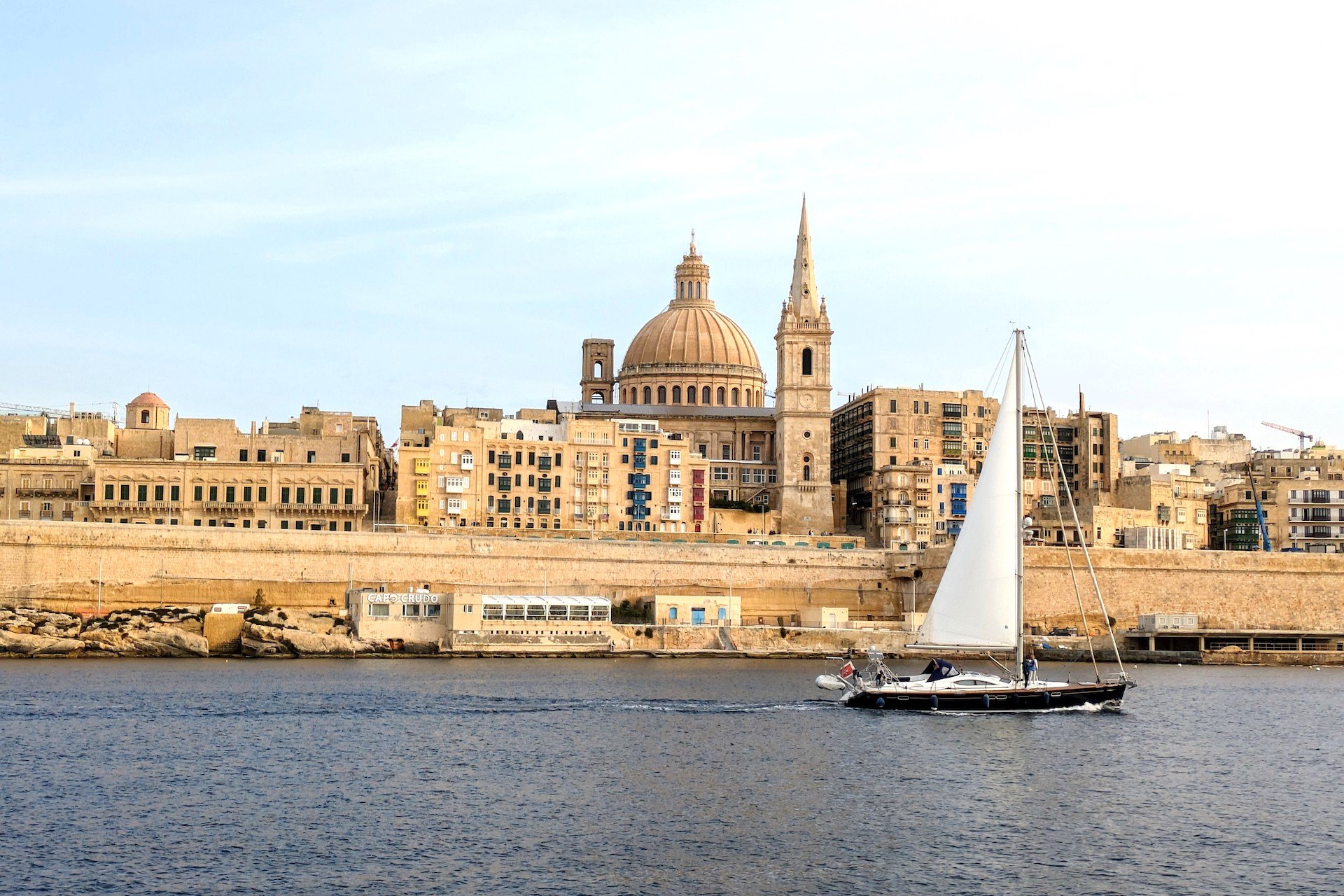
The architecture also tells the story: Victorian barracks, naval dockyards, the Upper Barrakka saluting battery and the Anglican cathedral’s spire on the Valletta skyline. A guided tour of Valletta is a good way to read these layers of history, from the Knights to the British era; our guide to Valletta lists the main sites.
How many Britons live in Malta?
According to the 2021 census by the National Statistics Office (NSO), around 10,600 British citizens were living in Malta, about 9% of the foreign population and the second-largest foreign nationality after Italians. The total number of foreign residents has grown fast since then, mainly through workers from outside Europe, but the British community remains one of the most established, with many long-term residents and retirees. For context on the country’s overall figures, see our page on the population of Malta.
Add to this a large number of Maltese-British families: generations of Maltese emigrated to the UK, and many have returned with British-born children or British spouses, which explains why British accents are so common in Malta.
British tourists: Malta’s largest market
The United Kingdom is by far Malta’s main source of visitors. The NSO’s inbound tourism figures for 2025 recorded 841,397 British tourists out of 4,022,310 arrivals, roughly one in five visitors, ahead of Italy and Poland. Direct flights from many UK airports take around three hours, and the island is busy with British holidaymakers all year round, from winter sun seekers to summer families.
For your first trip, our things to know before travelling to Malta and top attractions will help you plan beyond the familiar.
Living in Malta after Brexit
Brexit split the British community into two groups, as explained by Identità and the UK government’s Living in Malta guide:
- Britons legally resident before 31 December 2020 are protected by the Withdrawal Agreement. They hold a residence document issued under the Agreement and keep rights close to those of EU citizens (residence, work, access to services). The deadline to apply was 30 June 2021, but Identità still assesses late applications with reasonable grounds.
- Britons arriving since 1 January 2021 are third-country nationals. For a stay over 90 days, they need a residence permit adapted to their situation: a Single Permit to work for a Maltese employer, a Nomad Residence Permit for remote work, a retirement or residence programme, or a study visa. Check the rules in our visa guide before you move.
A few practical points from the UK government guidance: you can drive on your UK licence for up to 12 months after becoming resident, then you must exchange it for a Maltese licence; you can vote in local council elections but not in general elections; and a UK-Malta double taxation agreement prevents you from paying tax twice on the same income.
Retiring in Malta
Sunshine, English as an official language and a familiar culture make Malta a classic retirement choice for Britons. Beyond the residence permit itself, many retirees look at the Malta Retirement Programme, a special tax status under which foreign pension income remitted to Malta is taxed at a flat 15%, subject to an annual minimum tax, provided you own or rent qualifying property, hold health insurance and spend enough time in Malta. Applications are filed through an authorised registered mandatary.
The rules change on 1 January 2027: Legal Notice 195 of 2026 merges the existing programmes into new Individual Tax Programme Rules. For retired pensioner status, the minimum tax rises to €15,000 a year and the property threshold to a purchase of at least €700,000 or a rent of at least €14,000 a year. According to tax advisers in Malta, applicants covered by the transitional rules before 31 December 2026 remain under the current regime until 31 December 2031. Take independent tax advice before committing.
Healthcare for British visitors and residents
On holiday, the UK GHIC (or a still-valid UK EHIC) gives access to medically necessary state healthcare in Malta on the same terms as residents, at Mater Dei Hospital or the health centres. It does not replace travel insurance, which covers private clinics and repatriation.
UK state pensioners who move to Malta can register an S1 form, which gives access to Maltese state healthcare funded by the UK. Other residents generally rely on Maltese state healthcare once they pay social security contributions through work, or on private health insurance, which most residence permits require.
British institutions and meeting places in Malta
- The British High Commission in Ta’ Xbiex provides consular help to British nationals: emergency travel documents, support in case of arrest, hospitalisation or death, and guidance on living in Malta. Visits are by appointment only.
- St Paul’s Anglican Pro-Cathedral in Valletta, commissioned by Queen Adelaide, widow of William IV, who found no Anglican church on the island: the foundation stone was laid in 1839 and the building completed in 1844 on the site of the Auberge d’Allemagne. It is the seat of the Church of England chaplaincy of Malta and Gozo, part of the Diocese in Europe, with regular services in English and a visitor centre.
- The Royal Malta Golf Club in Marsa, founded in 1888 during the British period.
British life in Malta is also very informal: pub quizzes, football screenings, expat social groups and charity events are announced in the English-language press and on community networks, especially around Sliema, St Julian’s and the north of the island.
Pubs, food and British habits
The British influence is easy to taste. Pubs with draught ale, Sunday roasts, fish and chips and full English breakfasts are common in the resort areas, from St Julian’s and Sliema to Buġibba and Qawra. Valletta’s most famous drinking spot is a tiny bar on Archbishop Street simply called The Pub, where actor Oliver Reed spent his last evening in 1999 while filming Gladiator.
Do not stop there, though. Maltese cuisine borrows from Sicily, North Africa and Britain alike: try pastizzi with a cup of tea, rabbit stew, ftira and a local Cisk lager or Kinnie, the bittersweet orange soft drink. For a calmer pace, many Britons fall for Gozo, the greener sister island.
Frequently asked questions about the British in Malta
How many British people live in Malta?
The NSO’s 2021 census counted around 10,600 British citizens living in Malta, about 9% of foreign residents and the second-largest foreign nationality after Italians. The number of people with British roots is higher, as many Maltese families have British-born members.
Is English widely spoken in Malta?
Yes. English is an official language alongside Maltese, a legacy of British rule, and almost everyone speaks it. You can live, work and deal with the administration in English.
Can British citizens still move to Malta after Brexit?
Yes, but as third-country nationals. Beyond 90 days you need a residence permit linked to your situation (work, remote work, studies or retirement). Britons resident before 31 December 2020 keep their rights under the Withdrawal Agreement.
Is Malta still in the Commonwealth?
Yes. Malta has been a member of the Commonwealth since its independence in 1964, and it remained a member after becoming a Republic in 1974.
Do UK plugs and driving habits work in Malta?
Yes on both counts: Malta uses the same three-pin type G sockets as the UK and drives on the left. UK residents can also drive in Malta on their UK licence for up to 12 months after settling there.
The British connection with Malta is more than nostalgia: it is a living relationship built on a shared language, more than 800,000 British visitors a year and a community that has adapted to post-Brexit rules. Whether you are coming for a week, a few years or your retirement, you will feel at home quickly, so take the time to discover the Maltese side of the island too.