Renting a Car in Malta: The Complete 2026 Guide
Renting a car is the easiest way to reach the cliffs, coves and villages that buses serve poorly in Malta, and to explore Gozo at your own pace. The archipelago is small and fuel is among the cheapest in the European Union, but traffic drives on the left, roads are often congested and the parking rules can baffle visitors.
Here is what you need to know before you book: where to hire, what to budget, which documents to bring, speed limits, fines and what to do after an accident, all checked against official Maltese sources.
Why rent a car in Malta?
The bus network covers the whole island and ride-hailing apps are well established (see our guide to getting around Malta). The first thing a hire car gives you is freedom: you set off when you like, with no timetable to follow.
Then there is access. The Dingli Cliffs, bays such as Għajn Tuffieħa or Ġnejna, Ħaġar Qim temple and the viewpoints of the north often take several buses and a lot of time for just a few kilometres. By car, you can string together three or four sights in a day and pick your beaches in Malta according to the day’s wind.
Finally, comfort. In summer, buses are packed and sometimes drive past full. Ride-hailing remains handy for a night out (see our comparison of ride-hailing apps in Malta), but over a week of journeys a hire car quickly works out cheaper. On the other hand, if you are staying in Valletta, Sliema or St Julian’s and mostly exploring those areas, a car will be more of a burden than a help: traffic jams and parking are a real headache there.
Where to rent a car in Malta: online or at the airport
Booking online before you travel
Booking ahead is still the surest way to get a car at a fair price, especially from June to September and during school holidays, when the smaller categories go fast. A comparison site such as Rentalcars lets you line up the companies operating on the island, car categories, fuel policies and the insurance excess side by side. You can also book your hire car for collection at Malta Airport and drive away as soon as you land.
Before confirming, check three things: the fuel policy (go for “full to full”), the deposit that will be blocked on your card, and whether you are allowed to take the car on the ferry to Gozo.
Collecting your car at the airport
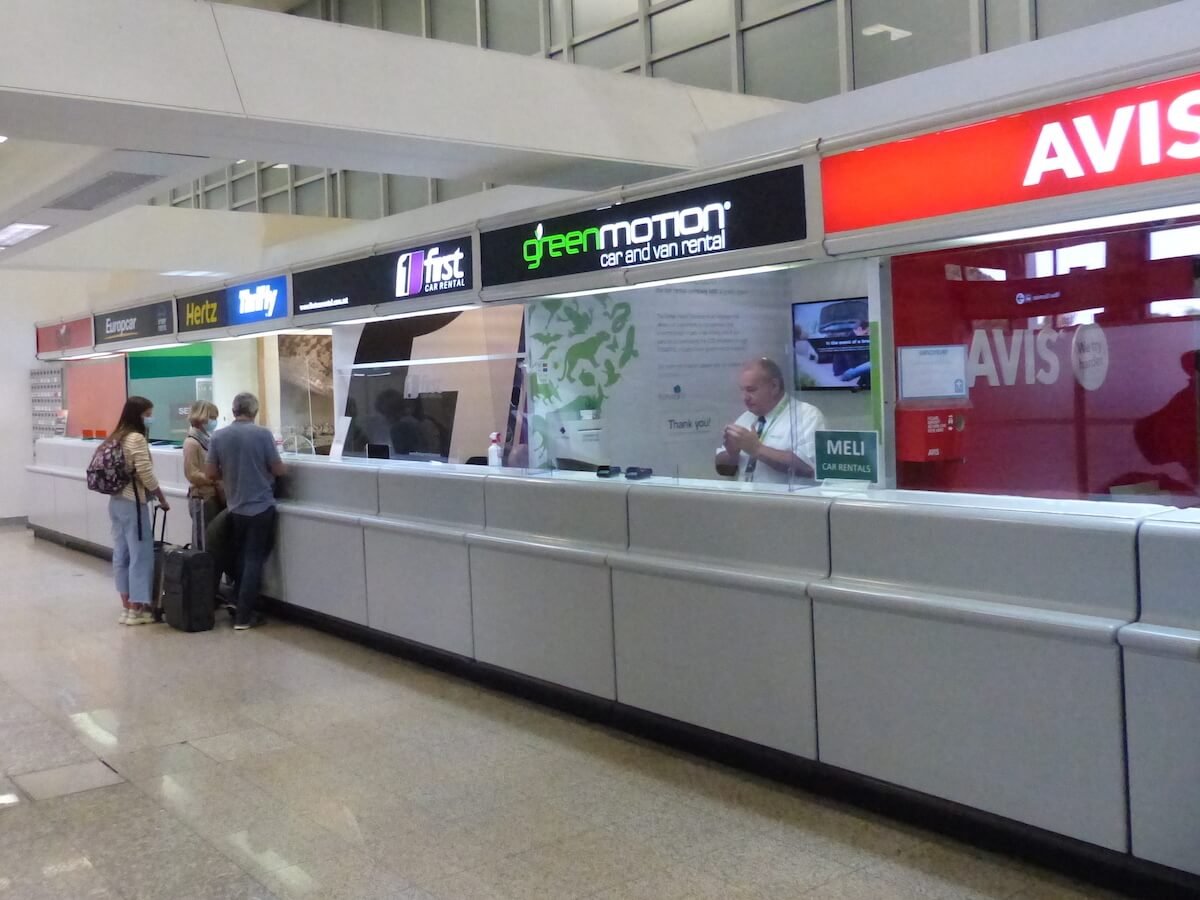
At Malta International Airport (Luqa), the rental desks are on Level 1 (the lower level) of the Park East car park, a separate building about a 3-minute walk from the terminal. Follow the “RENTAL CARS” signs on the floor, on the overhead boards and in the lifts. Hiring on the spot without a reservation is still possible, but availability is thin in high season and walk-up rates are rarely a good deal.
Car rental companies at Malta Airport
According to the list published by the airport, around thirty companies operate from Park East, including:
- the big international brands: Avis, Budget, Europcar, Hertz, Sixt, Enterprise, Alamo and National;
- European companies: Sicily by Car, Green Motion, OK Mobility, Free2Move, Addcar;
- Maltese firms: Malta First Car Hire, First Car Rental, Autounion, Drifter and Wheego, among others.
The smaller categories usually come with a manual gearbox: if you want an automatic, select it specifically when you book.
How much does car hire cost in Malta?
Car hire is affordable compared with other Mediterranean destinations, but rates vary widely with the season, the category and how far ahead you book. As a rough guide, a small city car costs a few tens of euros a day out of season, and considerably more in July and August. Booking several weeks in advance and comparing offers is still the best way to pay less.
Deposit, excess and insurance
The rental company blocks a deposit on a credit card in the main driver’s name; many refuse debit cards, and a few accept them under certain conditions. Basic insurance comes with an excess, the amount you still pay if the car is damaged: it often runs to several hundred euros, sometimes more. The Malta Tourism Authority recommends taking out comprehensive cover. You can reduce the excess at the desk, choose an all-inclusive package or check what your credit card covers.
Fuel and tolls
The good news is that fuel prices are regulated by the state and are among the lowest in the European Union. According to the European Commission’s Weekly Oil Bulletin, a litre of unleaded or diesel costs noticeably less than the European average, with prices fixed and stable for several years. There are no toll motorways and no vignette in Malta. The only road charge is the CVA system for entering Valletta (explained below), plus the ferry if you head to Gozo.
Age, driving licence and documents
The legal driving age in Malta is 18, but rental companies set their own rules: you generally need to be at least 21 (sometimes 23) and to have held your licence for at least a year. Under 25, expect a young driver surcharge billed per day. Some companies also have an upper age limit or charge extra over 70 or 75: check the terms before you book.
At the desk, you will need:
- your valid driving licence;
- photo ID (passport or national identity card);
- a credit card in the main driver’s name for the deposit;
- your booking voucher.
An EU or EEA licence is valid as it is. With a UK licence, according to the UK government, you can drive in Malta with a UK, Gibraltar or Jersey photocard licence without an International Driving Permit (IDP); with an old paper licence, update it to a photocard or get an IDP (the 1949 version is the one for Malta), and Guernsey or Isle of Man licence holders may need one too, so check with the Maltese High Commission.
With any other licence (United States, Canada, Australia, India and so on), Transport Malta allows you to drive for a maximum of 12 months from your last entry into the country. The IDP is not a stand-alone document: it accompanies your national licence. It is strongly recommended if your licence is not written in the Latin alphabet, and some rental companies require it for non-EU licences.
Whatever your licence, check the rental company’s own conditions before you book: they can be stricter than the law.
Road rules and fines in Malta
The essential rules
- Drive on the left on all the islands, and overtake on the right, just as in the UK and Ireland.
- Speed limits: 50 km/h (about 30 mph) in built-up areas and 80 km/h (about 50 mph) outside them, unless signs say otherwise. Some roads have different limits, so always follow the signs. Fixed speed cameras are installed on many main roads, and limits are shown in km/h only.
- Alcohol: the limit has been 0.5 g of alcohol per litre of blood since the 2018 reform (down from 0.8 g), and 0.2 g/l for novice drivers. That is stricter than the limit in England, Wales and Northern Ireland. The safest option is not to drink at all if you are driving.
- Mobile phones: banned at the wheel, including with earphones.
- Seat belts are compulsory in the front and back, and children need a suitable restraint: book the child seat at the same time as the car.
How much are the fines?
Penalties were increased in May 2023. As a guide:
| Offence | Fine |
|---|---|
| Speeding by up to 15 km/h | €34.94 |
| Speeding by more than 15 km/h | €100 |
| Using a phone while driving | €200 and 6 to 9 penalty points |
| Running a red light | €200 |
| Drink-driving | over €1,000, with possible licence suspension |
Fines for a hire car are sent to the rental company, which passes them on to you, usually with an admin fee, sometimes several weeks after you get home. The full list is on the Maltese government’s Land Transport Driving Offences page.
Driving in Malta: our practical tips
Roundabouts, roads and navigation
Because traffic drives on the left, you go round roundabouts clockwise and give way to vehicles coming from your right that are already on the roundabout. Take your time on the first few, especially if you normally drive on the right.
Main roads are in good condition, but minor roads can be narrow, bumpy and poorly lit outside towns. Local driving is assertive, so stay alert. Google Maps works very well across the islands, but does not always keep up with the many roadworks, so expect the odd diversion. Make sure you have mobile data: EU plans roam in Malta at no extra cost, but UK and other non-EU plans may charge, so check with your provider or pick up a local SIM. Choose a small car: it squeezes more easily through village streets and is much easier to park.
Parking: understanding the colours
- White bays: open to everyone, sometimes time-limited (read the sign).
- Blue and green bays: linked to residents’ parking schemes, reserved for residents at all times or at certain hours depending on the locality. The sign next to the bay is what counts.
- Yellow lines: no stopping or parking.
In public car parks, attendants sometimes keep an eye on cars: tipping is optional. In the evening, finding a space in St Julian’s or Sliema can take a while.
Valletta, Mdina and the CVA charge
Access to Valletta is subject to the CVA (Controlled Vehicular Access) system: cameras read number plates at the entrance. On weekdays, the first 30 minutes are free, then access costs €0.82 an hour, capped at €6.52 a day; entries after 2pm, at weekends and on public holidays are free. There is no barrier: the bill goes to the rental company, which passes it on to you, often with a fee. The simplest option is to park in Floriana, just outside the bastions, and walk the rest. In Mdina, traffic is restricted to residents: use the car parks outside the walls.
What to do after a road accident
If anyone is injured or it is an emergency, call 112. For a collision with no injuries, the procedure depends on the type of accident:
- Rear-end collision (front of one car into the back of another, no injuries): you can fill in the “Front to Rear” form supplied by insurers with the other driver, without calling the police or wardens.
- Any other collision: call LESA (Local Enforcement System Agency) on +356 2132 0202, a line dedicated to accident reports. An officer draws up the report, which the rental company’s insurer will need.
Then let your rental company know as soon as possible and follow its instructions. Exchange names, registration numbers and insurance details with the other party, photograph the scene and the damage, and always keep the rental agreement and vehicle documents in the glovebox.
Taking a hire car to Gozo
Most rental companies allow you to take the car to Gozo, but some set conditions or limit roadside assistance on the island: check before you book. Cars board Gozo Channel ferries between Ċirkewwa, at the northern tip of Malta, and Mġarr in Gozo. The crossing takes about 25 minutes and the service runs day and night, with less frequent sailings at night. The fast ferries from Valletta carry foot passengers only.
One quirk: you pay nothing on the way out. The return ticket is bought on the way back, at the vehicle ticket booths in Mġarr, or online in advance. Current fares:
| Return ticket | Fare |
|---|---|
| Car and driver | €15.70 |
| Car and driver, night fare (leaving Mġarr after 8pm, November to March) | €12.80 |
| Adult passenger | €4.65 |
| Child aged 3 to 12 | €1.15 |
| Child aged 0 to 2 | free |
In summer and at weekends, the queue to board can be long, especially coming back on a Sunday evening. Once there, a car is ideal for linking Victoria, Dwejra, Xlendi and Ramla Bay: our pick of things to do in Gozo will help you plan the route. If you would rather not drive, a Gozo jeep tour or the Gozo hop-on hop-off bus are good alternatives. As for Comino, the car stays at the port: the island is car-free and can only be reached by boat.
Frequently asked questions about renting a car in Malta
Where is the best place to rent a car in Malta?
The most convenient option is to book online, for example through Rentalcars, then collect the car at the airport, in the Park East car park.
Do I need an International Driving Permit to drive in Malta?
Not with an EU licence or a UK photocard licence. With another non-EU licence, your national licence is valid for 12 months, but an IDP is recommended, and some rental companies require one.
How old do you have to be to rent a car in Malta?
Usually 21, with at least a year’s driving experience, plus a young driver surcharge under 25.
What are the speed limits in Malta?
50 km/h in built-up areas and 80 km/h outside them, unless signs say otherwise. Speeding by up to 15 km/h costs €34.94, and €100 beyond that.
Can I take a hire car to Gozo?
Yes, most rental companies allow it. The return ticket for a car and driver (€15.70) is paid on the way back, in Mġarr.
What should I do after a minor accident with no injuries?
Rear-end collision: fill in the “Front to Rear” form with the other driver. Otherwise, call LESA on 2132 0202, then your rental company. If anyone is hurt, call 112.
With a little preparation, a hire car opens up the whole archipelago, from Dingli to Gozo, on a reasonable budget thanks to cheap fuel. Book early, choose a small car and a low excess, photograph the vehicle before you set off, and keep three habits in mind: drive on the left, read the parking signs and steer clear of central Valletta on weekdays. For the rest of your trip, see our tips for travelling to Malta.